Greek Orthodox Easter – customs and traditions
Greek Orthodox Easter, the biggest celebration of the year for most Greeks, with a lot of special traditions and family gatherings.
The preparations for Easter actually start from “Kathara Devtera” (Clean Monday) onward. On February 23rd, 2026 all Greeks celebrate the national holiday “Kathara Deftera” , which is the last day of carnival and the first day of the so called “fasting period”.
Kathara Deftera is the day Greeks fly kites *(which are symbolic of the Resurrection) and go on picnics outdoors. The holiday is also the unofficial start of spring for Greeks.
From that day onward till Easter people might greet you with “kali sarakosti” (Have a nice 40 days!), since there are 40 days left till the “holy week” (the week before Easter Sunday). On Kathara Devtera you DO NOT eat meat, but mostly fish, vegetables, and “laganas” (special bread). Kathara Devtera is the first day of the so called “fasting period” and the last day of Carnival.
Most people do not bother about the “fasting” anymore after Kathara Devtera, but start fasting again for just one week before Easter, during the so called “holy week”! Nevertheless, for those that can do without eggs, milk, meat, etc… for 40 days, in every shop you will find “nistissima”, the foods you can eat during the “fasting period”.
Easter in Greece is a very special and holy time indeed! Even for non-religious Greeks or students, the atmosphere is nice and it is a part of the Greek Culture and Traditions.
During the evenings of the holy week you can hear the church services every day, with on Good Friday the candlelit funeral processions. On Saturday evening, 90% of the Greeks hurry to church around 23.30 and witness the priest bringing in the Holy Flame, flown in from Jerusalem (lets pray there is no strike!!) .
On Saturday night the Greeks eat the famous “mayeritsa” soup!
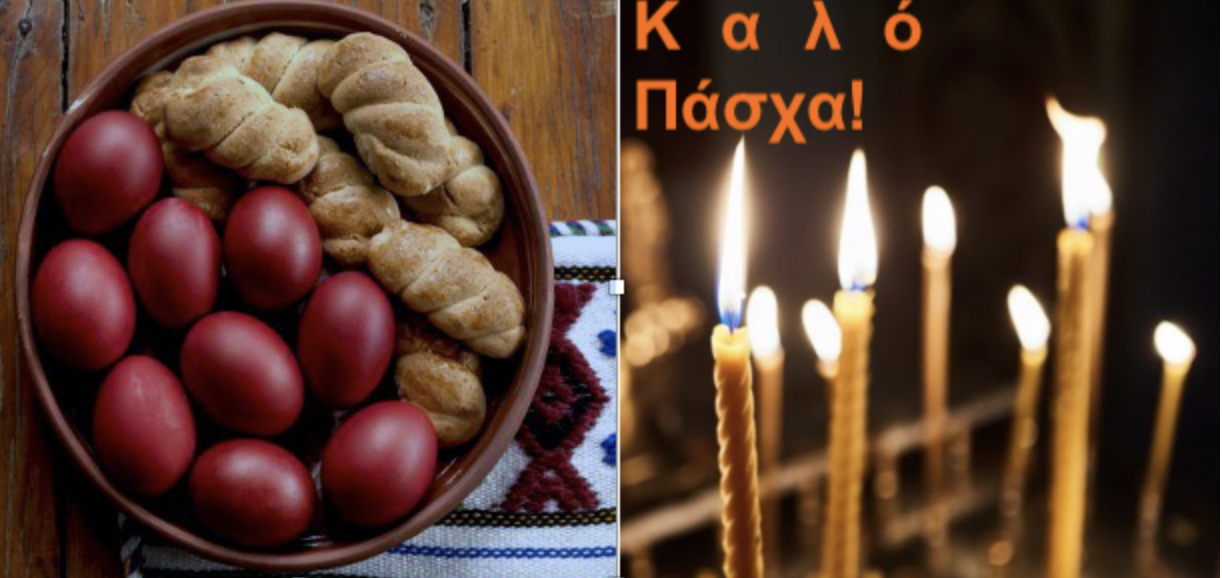
During the whole week till Saturday evening you can greet each other with the usual “Xronia Polla”, but also with “Kalo Pascha” (Happy Easter) or otherwise “Kali Anastasi”.
However, from Saturday midnight you greet people with “Christos Anesti” (Christ resurrected) and you are supposed to answer with “Alithos Anesti” (yes he truly resurrected!)
Greek Easter is a very special and holy time indeed. Even for non-religious Greeks, the atmosphere is special and it is a part of the Greek culture and traditions. During the evenings of the holy week, you can hear the church services every day. On Good Friday the candlelit funeral procession takes place in every church.
Easter Sunday means eating Greek lamb, goat, kokoretsi, wine, tsoureki bread and cracking red eggs, while visiting family , friends, dancing the Greek dances, etc….…..but also enjoying the beautiful nature and wild flowers everywhere.
For those that are vegetarian, do not worry! Greece is probably the easiest place to always find plenty of vegetable dishes. However, be prepared, at Easter probably every Greek will try to convince you to taste some lamb!
- Kite-flying
One traditional activity on Clean Monday is kite-flying. When the weather allows it, young and old, families and friends go to the countryside or the beaches and try to fly a kite.
In the past, the kites used to be handmade by the father or grandfather of the family. Thus, the art of kite making was passed on from one generation to the other. Today most people buy a kite instead of making it. Either way, it is a great bonding activity for families.
The kite symbolizes the human soul flying up into the sky, free and pure, the passing of the human soul to Heaven and God. Through this process, the believers are getting ready for the Ressurection of Jesus Christ and the Orthodox Easter.
People in older times believed that the higher their kite flew the more possible it would be for their prayers to be heard by God. The custom of flying kites on Clean Monday is directly linked to the spiritual state of mind of Orthodox Christians: on this day, they start on the path of physical and spiritual purification, through a long fasting period, and thus rededicate themselves to a more righteous way of living.
The custom of flying a kite goes back to ancient China, to at least 1,000 BC.
The first kite in Greece appeared in ancient times, around 400 BC. At that time, mathematician and engineer Archytas (440-360 BC), from Taranto, southern Italy, is said to have invented the first kite in Greece for his aerodynamics studies.
The first kites that were spotted in Greece in the post-modern era came from the eastern areas and more specifically Chios and Samos, until they eventually made their way to the city of Patra and became common all around the country.
Learn more about Greek Easter here.
- Holy Monday to Holy Wednesday
- Holy Thursday – Red-Dyed Eggs
- Holy Friday
- Holy Saturday – Jesus Christ’s Resurrection
- Easter Sunday – The Traditional Spit-Roasted Lamb of Greek Easter
- The meaning of ‘Kali Anastasi’
- Greek Easter decorations
We wish all our readers celebrating Easter here in Crete Καλό Πάσχα !
The Kissamosnews Team